- The reported tests concern a shared-propellant dual-mode system, rather than proof of every planned orbital maneuver.
- Thrust and propellant efficiency describe different qualities.
- Integration can save hardware while creating shared dependencies that need verification.
The concrete experiment
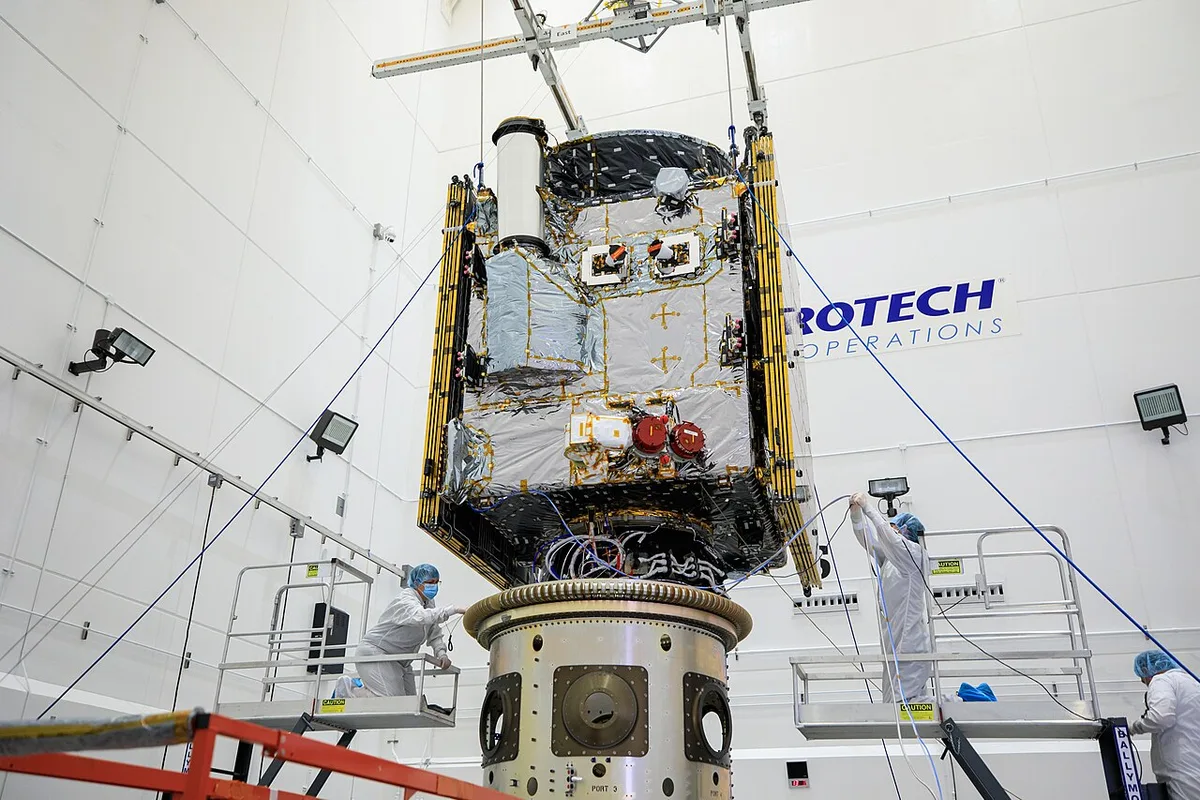
NASA’s September 25 development report describes a small spacecraft designed to feed chemical and electrospray propulsion from a common tank of ASCENT propellant. The agency reports environmental and physical tests performed before launch preparation. The cited update establishes those ground milestones; it should not be treated as evidence that all subsequently planned flight maneuvers have already occurred. The interesting question is whether a compact integrated system can provide two useful modes of motion without carrying two fully separate fluid infrastructures.
This is not simply a matter of making an engine smaller. Different mission tasks benefit from different combinations of force, duration and resource use. A dual-mode system attempts to serve more of those tasks while sharing equipment, making its interfaces and operating rules central to the result.
A fast maneuver and an efficient maneuver are not identical
Thrust describes force. A higher thrust can change velocity more quickly, which is useful when a maneuver has to occur within a limited interval. Propellant efficiency concerns how effectively the carried propellant produces the desired change in motion. A system can be efficient while delivering a relatively small force over a longer period.
Neither characteristic is automatically superior. A mission may need a prompt correction at one stage and a gradual adjustment at another. Selecting propulsion requires matching the available power, propellant and time with the trajectory. This is why a headline promising both high and low thrust should lead to questions about the tasks each mode actually supports, rather than an assumption that one vehicle now has unlimited maneuvering flexibility.
Sharing a tank changes the integration problem
Separate systems need separate storage, lines and associated hardware. Sharing can reduce duplication, but it connects requirements that were previously independent. Both propulsion modes must receive propellant in a usable state through a system that remains compatible with each one.
The fluid path needs a clear account of isolation, pressure and operating transitions. A change associated with one mode must not create an unacceptable condition for the other. The design should also explain which failures affect a single capability and which affect the shared resource. Reducing parts can improve simplicity in one sense while concentrating importance in the remaining parts. The correct evaluation considers the integrated operating behavior rather than counting tanks and declaring the reliability question settled.
Ground tests establish specific facts
Leak testing examines containment under defined conditions. Thermal-vacuum testing examines behavior in a controlled combination of low pressure and temperature exposure. Mass-property measurements support an understanding of how the assembled vehicle responds to applied forces and torques. Each test addresses a different part of readiness.
A successful result is meaningful when the conditions and acceptance criteria are clear. It does not establish every future flight behavior. For example, containment evidence does not by itself show that the transition between propulsion modes performs correctly during an orbital sequence. The most useful verification plan connects component tests with integrated functional checks, preserving a traceable relationship between a requirement and the evidence used to satisfy it.
The spacecraft must point while it pushes
A thruster acts along a direction determined by its installation and the spacecraft’s orientation. If the force does not align with the intended geometry, part of the effort can create unwanted rotation or change motion in an unintended direction. Attitude control and propulsion therefore work as a coupled system.
A small spacecraft has limited room for arranging equipment and balancing its mass. As propellant is consumed, the mass distribution can change. Operational planning should account for those relationships when deciding which mode to use and how long to operate it. An efficient propulsion unit cannot deliver its full mission benefit if the rest of the vehicle cannot maintain an appropriate orientation, power state or communication arrangement during the maneuver.
What useful orbital evidence would show
Flight evaluation should connect a commanded maneuver with the measured change in the vehicle’s trajectory. It should also record power, timing and the condition of relevant equipment. This allows the team to distinguish a functioning thruster from a propulsion system that performs predictably as part of the spacecraft.
Transitions deserve explicit attention. A system advertised as dual-mode should demonstrate that the shared architecture supports both modes under relevant conditions, not merely that each can operate separately in a favorable setup. Repeated sequences can reveal effects that a single activation misses. Clear evidence would state which operations were performed, which remained planned and how the measured behavior compared with the assumptions used in mission design.
A practical way to compare maneuver options
Consider a spacecraft that must make a correction before a particular observation opportunity. A low-thrust option could use propellant effectively but take longer than the available interval. A higher-thrust option might complete the correction promptly while consuming a different share of the carried resource. The useful choice depends on the deadline and on what the vehicle must still do afterward. A comparison that ignores time would miss a central requirement.
Now consider a long interval in which the same vehicle can adjust gradually. The power available during that period, communication schedule and required orientation may determine whether electric operation is attractive. The planner needs to account for every supporting activity, including how the vehicle verifies that the accumulated motion matches the intended result. These examples explain why dual-mode capability is valuable only when its operating constraints are understood.
For readers, a revealing mission diagram would show which tasks use each mode and which resources limit them. Such a diagram turns a broad claim of flexibility into a set of checkable engineering choices. It also identifies the circumstances in which sharing hardware offers a benefit and the circumstances in which a separate architecture might remain appropriate. No single performance number can replace that task-level comparison.
The practical significance of integration
The potential benefit is flexibility within a constrained vehicle. If shared storage supports the required maneuvers reliably, mass and volume can be available for other functions. That benefit must be evaluated at spacecraft level, including power electronics, control equipment and the operating margins associated with both propulsion modes.
A useful comparison would hold the mission requirements constant and examine the full integrated alternatives. Comparing only the size of a tank with the size of two tanks would omit important differences. NASA’s experiment is therefore best followed as a systems demonstration: a test of whether reduced duplication becomes a practical capability when the spacecraft must actually operate.
The enduring lesson is that propulsion choices are relationships between hardware and mission needs. A shared resource can be an intelligent design when its dependencies are understood. Readers should look for the evidence that establishes those dependencies in use, keeping ground qualification, orbital operation and projected benefits distinct rather than treating them as interchangeable claims.
Sources & further reading
Primary references inform the reporting. Our explanations, scenarios, and conclusions are editorial analysis; source statements are not independent test results.
Source publication or reference date: 2026-09-25.
See an error or an important update? Contact the editors.